Peshtemal vs Terry Towel: Which Is Better for Your Brand?

Neither is simply better. A peshtemal (Turkish towel) wins on weight, drying speed, versatility and style, while a terry towel wins on plushness and that wrapped-in-a-cloud feeling after a hot shower. For most promotional programmes built around travel, beaches, pools, spas and events, the peshtemal is the smarter pick. For bathroom-bound gifts, terry still has the edge.
Below is a practical way to decide, written for people who choose products on behalf of brands: where each towel shines, where it struggles and what that means for your client's logo and budget.
What is the real difference between the two?
It comes down to construction. A terry towel is woven with extra yarns that form loops standing up from the base cloth. Those loops trap water and create the thick, soft surface everyone recognises. A peshtemal is flat-woven, with no loops, so it is thinner and relies on the cotton fibre and open weave to absorb and release moisture.
Almost every other difference follows from that single fact. Loops add bulk, weight and drying time. No loops means a cloth that folds small, dries fast and sheds sand. If you want a refresher on the cloth itself, start with What Is a Turkish Towel?
Peshtemal vs terry at a glance
| Question | Peshtemal | Terry |
|---|---|---|
| How does it feel? | Light and cool, softer with each wash | Thick and plush immediately |
| How fast does it dry? | Quickly, often hung up and dry within a short time | Noticeably slower, especially when thick |
| How much room does it take? | Folds to a small, flat bundle | Bulky in a bag or suitcase |
| What about sand? | Shakes off easily | Loops can hold on to sand |
| Can it do more than dry you? | Yes: wrap, throw, scarf, picnic cloth, shawl | Rarely |
| How does it handle a logo? | Flat surface keeps edges clean | Pile can blur fine detail |
| How does it ship and store? | Light and compact | Heavier and bulkier |
| Best for | Beach, pool, spa, gym, travel, gifting | Bathroom, bedroom, cosy home use |

When should a brand choose a peshtemal?
Pick the Turkish towel when one or more of these is true.
The recipient will be on the move
Conference swag that travels home in a carry-on, a resort welcome gift, an event giveaway: all of these benefit from a towel that folds small and weighs little. A bulky towel is the first thing people leave behind, and a towel left behind is a logo that does not travel.
Water and sand are involved
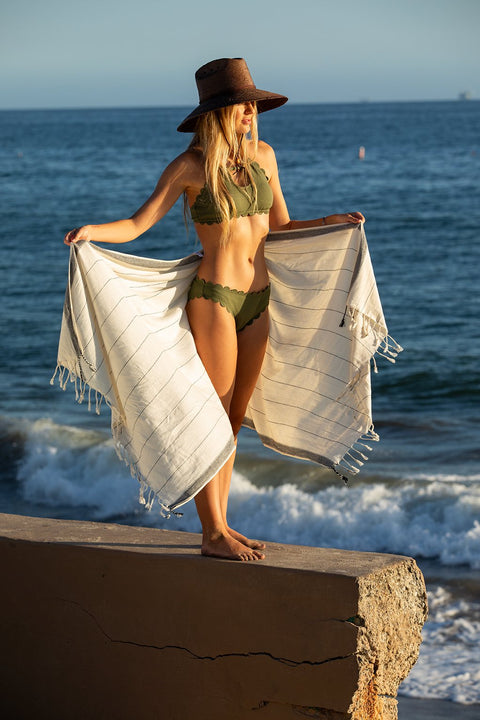
Beach clubs, pool parties, boating, surfing and coastal weddings are peshtemal territory. The flat weave dries quickly and lets sand fall away, which makes it far more pleasant at the water's edge. It also suits our mission: we want to help heal and protect the oceans, and a product made for coastlines feels like a natural fit.
The logo is the point
A flat surface is a better canvas than a looped one. With jacquard weaving, the logo becomes part of the fabric. With embroidery, it gains texture. With printing, colourful artwork stays vibrant. Our decoration guide compares the three in depth.

Shipping, storage or drop shipping matter
Thin towels take up less warehouse space and pack into smaller parcels. For distributors holding stock or sending individual orders to recipients, that adds up. We can pack and ship custom orders and support distributor drop-ship workflows, and a compact product keeps the logistics simple.
You want a gift that looks like a gift
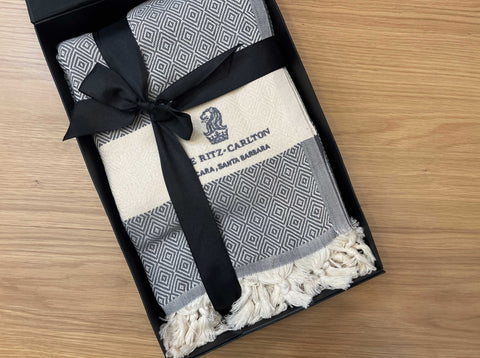
Rolled, tied or tucked into a branded sleeve, a peshtemal looks elegant. It reads as considered rather than generic, which matters when the recipient is a client, a VIP or a donor.
When is terry the better choice?
We make flat-woven towels, so you might expect us to dismiss terry. We will not, because the honest answer helps you more.
- Bathroom use. After a shower, many people simply prefer the thick, cosy feel of terry.
- Cold climates. Extra bulk means extra warmth when drying off in a chilly room.
- Plush-first brands. If your client wants to communicate indulgence through softness alone, terry delivers on day one.
- Traditional expectations. Some audiences, such as a gym that always supplied terry, may expect it.
If your programme is bathroom-focused, you may be better served by a robe or a blanket than by either towel type. We cover those in Custom Bathrobes and Cover-Ups.
Terry is built to be cosy at home. A peshtemal is built to go places.
Which is better for absorbency?
This is the question everyone asks, and the answer needs nuance. Terry holds more water per towel because of its loops and volume. A peshtemal holds less at once, but it is made of cotton, which is naturally absorbent, and its thin structure lets that water leave again fast. In practice you dry yourself perfectly well with a peshtemal, and then it dries itself in a fraction of the time. A terry towel that stays damp in a beach bag is a very different experience.
So the real comparison is not "which absorbs more" but "which stays pleasant to use". For travel and water, the peshtemal tends to win. For one-and-done showers at home, terry is fine.
Which lasts longer and wears better?
Quality matters more than type. A well-made peshtemal in long-staple cotton can serve for years and tends to soften with age. A cheap terry towel can shed lint and thin out quickly, while premium terry also lasts. When comparing, judge the yarn and weave rather than the category. Our article on Turkish cotton explains what to look for.
What are the common myths about Turkish towels?
"They are too thin to be luxurious." Luxury and thickness are not the same thing. A fine, long-staple cotton peshtemal feels refined and gets softer over time, and it is the cloth traditionally used in some of the oldest bathing rituals in the world.
"They are only for the beach." The beach is their showiest use, but they work as spa wraps, gym towels, travel towels, throws and kitchen cloths. That range is part of the value for a recipient: a more useful item is a more visible logo.
"They are scratchy." A new peshtemal can feel crisp, and that is normal. It relaxes with the first few washes. Scratchy usually points to short-staple cotton or poor finishing rather than the flat weave itself.
"Terry is always the safer choice." Familiar is not the same as best. If your client's audience travels, swims or hosts events, the safe choice is the towel that suits the moment, which is often the lighter one.
How do the two compare on budget and logistics?
We will not quote prices here, because they depend on style, quantity and decoration. What we can describe is the shape of the trade-off. A flat-woven towel uses less material overall and weighs less, which tends to help with freight, storage and packaging. A thick towel needs more of all three. Decoration choices then add their own variables, so it is worth asking for a quote on the full finished product rather than the blank towel alone.
If your client wants to mix colours or styles to hit a price break, our pooled quantity breaks make that straightforward. It is a useful way to offer variety, such as a colour per department or event, without losing the better pricing tier.
A quick decision guide for distributors
Run through these questions with your client and the answer usually appears within a minute.
- Where will the towel be used most? Water, travel or events point to peshtemal. Bathroom points to terry.
- Will it be packed or carried? Yes means peshtemal.
- How important is logo clarity? Very important means peshtemal.
- Is shipping or storage a concern? Yes means peshtemal.
- Is plushness the main promise? Yes means terry.
Yes. Use "Request Virtuals" to preview your client's logo on a peshtemal, and "Request Samples" to let them feel the cloth. Seeing and handling one tends to settle the debate faster than any spec sheet.
What does ordering a custom peshtemal involve?
You can start from what is on hand. Some inventory is ready to ship from California, and additional inventory in Turkey ships in 7-10 days; see the inventory page. For fully custom pieces, made-to-order production takes about two weeks in Turkey. Wholesale pricing is available to logged-in distributors, and quantity price breaks are pooled, so mixing colours or styles earns the break of the lower-priced style. Finishing options include custom hang tags, woven labels, branded belly bands or sleeves and personalised packaging.
Frequently asked questions
Is a Turkish towel as absorbent as a regular towel?
A terry towel holds more water at once, but a Turkish towel is made of absorbent cotton and dries you effectively, then dries itself far faster. For beaches, pools and travel that quick drying usually makes it the more pleasant towel.
Which is better for promotional products, a peshtemal or terry?
For most promotional uses involving travel, water or events, the peshtemal is better. It is lighter and cheaper to ship, and its flat surface shows a woven, embroidered or printed logo more cleanly.
Do Turkish towels shed sand?
They shed sand much more easily than looped terry because there are no loops to hold it. A good shake usually clears most of it, which is a big reason they are popular at the beach.
Can I offer both types in one programme?
Yes. Many programmes pair a peshtemal for travel and water with another textile, such as a blanket or robe, for comfort at home. Mixed styles can also share pooled quantity price breaks.
Not sure which is right for your client?
See what is ready to ship, or talk to us about samples and virtuals so you can compare with real cloth.
Browse inventory Talk to our team